- 01Data
- 02Training
- 03Model
- 04Product
- 05Human
301
Choose your machine.
The logo comes after the job.
Why are there so many models and tools?30–37 min

The logo comes after the job.
The logo comes after the job.
Would you ask a text model to figure out what’s in a photo of a stone you found? Would you ask an image model to help design the turret mechanism for your tank? Every job wants a different kind of help — work that out before you even think about which app to open.
A text model can turn a chapter of notes into study cards — but hand it a photo of a stone and it’s lost. That’s an image model’s job. Sound, video, code, and an actual robot body each need their own kind of machine too. Six different kinds of stuff, six different machines.
Text models chop words into pieces called tokens. Image models often shrink a picture down into a compressed version called a latent space before reshaping it. Audio models turn sound into waveforms and tokens together. None of that changes the basic idea on this slide — it’s just the machinery underneath it.
Making something brand new is a different job from sorting things into piles, which is different again from just finding a fact that already exists somewhere. Turning a chapter of notes into study cards is a different job from turning off a light with your voice. Same word — “AI” — five completely different jobs underneath it.
On its own, the model can only suggest words or an idea. Hook it up to a tool and now it can search the web, do the maths, save a file, send a message, or move something in real life — which is exactly why it shouldn’t be allowed to do that without someone saying yes first.
Once a system can act instead of just talk, permission, double-checking, and a clear off-switch matter a lot more than how smooth it sounds.
guesses, ranks, labels — just words
actually searches, calculates, saves, sends, or moves something
Six real jobs. For each one: what kind of model does this, does it need a tool, and where does the fact come from? Figure out what kind of stone is in a photo. Design a working turret mechanism for a Lego tank. Turn a chapter of notes into study cards. Check tomorrow’s train time. Write a short tune. Turn off a light with your voice.

The stone photo and the turret design both need a model that can see. The train time needs a live lookup, not a guess. Routing the wrong one is the most common miss.
Start with pure static, like a detuned TV screen. The model slowly swaps bits of that noise for patterns that match your words, over and over, until a picture appears. Same trick whether you’re asking for a dragon or sketching out what a stone you found might look like polished.
This step-by-step noise-clearing process is called diffusion. Many models do the clearing on a squeezed-down version of the picture — a latent space — then blow it back up to full size pixels at the very end.

One system can turn a voice recording into written words. Another can work with those words, and a voice generator can turn the result back into sound. That’s the loop behind any AI helper you talk to instead of type — say it out loud, it writes down the words, works with them, and can even read the answer back to you.
First it searches for real pages. Then it puts the best bits of those pages on its desk and writes an answer using them. Then you open the actual links and check it hasn’t quietly made anything up.
Search-then-write is often called retrieval-augmented generation, or RAG for short. The answer is only ever as good as what got found — if the search misses the right page, no amount of good writing fixes that afterwards.
One of these is stuff it learned ages ago, during training. One is whatever’s in the chat right now. One is a note it saved on purpose for next time. And one is a file or page it just went and grabbed because you asked. All four can feel like “it remembers” — they’re not the same thing at all.
Training
patterns learned long before you ever showed up
Context
what’s on the desk right now
Saved memory
a note it kept on purpose, for later
Fetched just now
a file or page it went and grabbed because you asked
A hosted model lives on a company’s computers — you just visit it. An open-weight model lets anyone download the trained number-dials themselves. A local model runs right there on your own computer. Some models manage to be both open-weight and local at once.
You might be able to download the number-dials but not the training data or the code that made them — “open-weight” and “open-source” aren’t the same promise.
Hosted model
you visit it online; the company runs the machine
Open-weight model
you can download the trained number-dials, if the licence allows it
Local model
it runs on your own device; you’re in charge of updates and limits
The most powerful option might cost more, need the internet, or send your stuff to someone else’s computer. A private option running entirely on your own device might be slower, or just not as sharp. There’s no single winner here — only what matters most for whatever you’re actually trying to do.
This is the shape of the decision, not a real scorecard for any actual model.
Every big AI company actually sells a whole family of models, not just one. Some in the family are built to think harder and slower. Some are built to be fast and cheap. One family you can download and run yourself. None of them is “the best” — they’re just built for different jobs. Names and limits change fast, so check the date on this before trusting it.
Sol / Terra / Luna · you visit it online · holds about 1.05 million words at once
Fable / Opus / Sonnet · you visit it online · holds about 1 million words at once
Pro / Flash / Flash-Lite · you visit it online · handles text, pictures, and more
Scout / Maverick · you can download it yourself · handles text, pictures, and more
This is what each company says about itself, not an outside ranking of who’s best. Double-check before you trust it — this stuff moves fast.
A context window is just how much stuff a model can look at in one go — think of it as the size of its desk. A model with a huge desk can hold an entire textbook chapter you want turned into study cards. But a bigger desk doesn’t mean it reads every line carefully — something buried in the middle can still get missed.
These bars are squashed so tiny numbers still show up next to huge ones. These are the limits each company states — how well a model actually uses all that space depends on the job.
A benchmark is the same fixed test given to every model, like a spelling bee — good for comparing, but it isn’t your test. Turning a chapter of notes into study cards cares about totally different things than designing a turret mechanism does: different facts matter, different mistakes matter, different idea of “good enough.”
the same test for every model — good for comparing, not built for your job
your own examples, your own limits, your own idea of good enough
Ask two systems the exact same real question — how to build a working turret mechanism, say — using the exact same facts. Cover up the logos so nobody knows which is which. Then score them the same way: right answer, useful answer, real links, how fast, and whether either one owns up to a mistake.
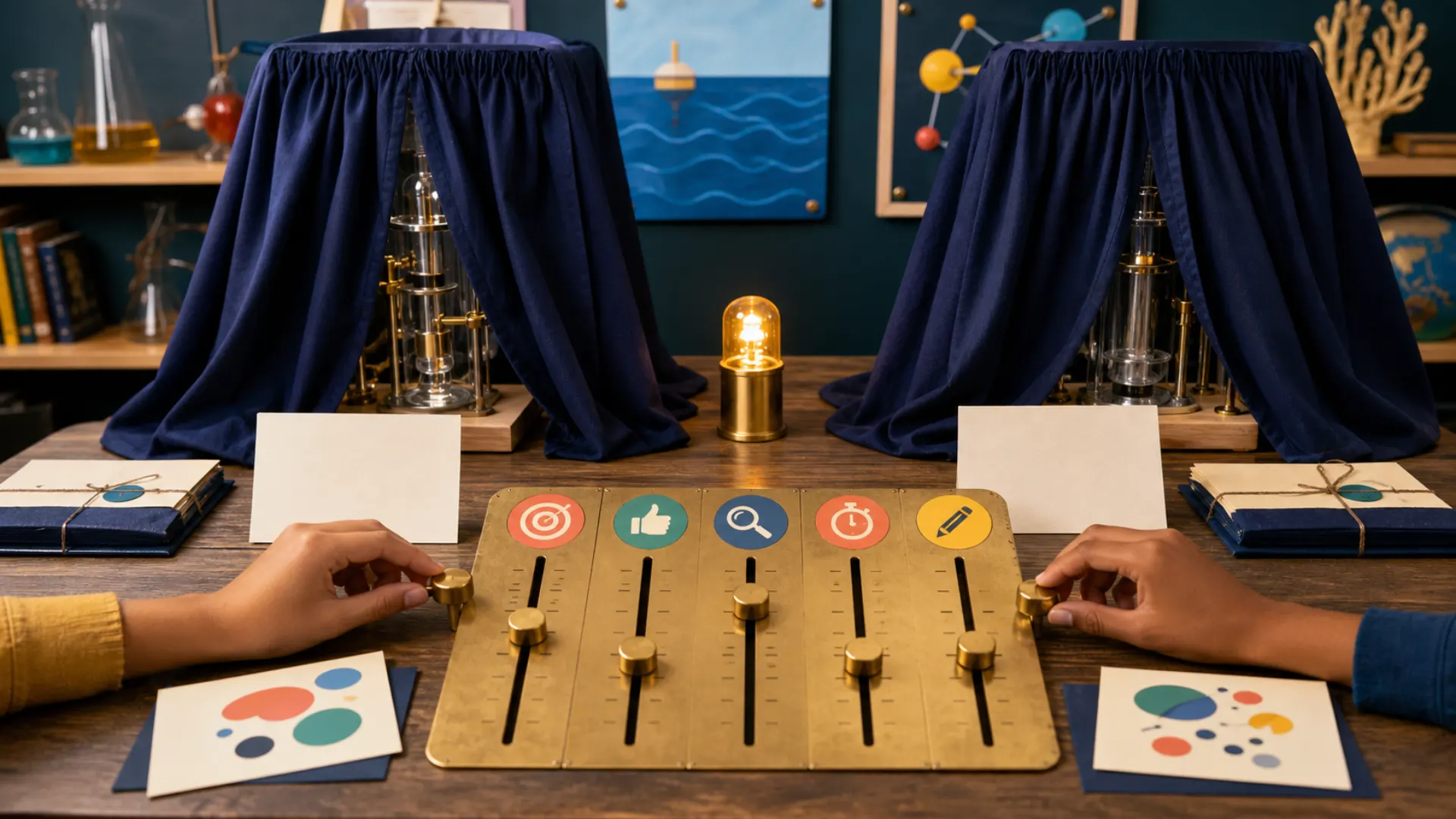
A scoring rule written after seeing an answer tends to bend toward whichever one already sounds better. Write the rule first, or the test isn’t really blind.
Ask something current — like checking what a stone might actually be worth today — with no tools switched on. Then ask again with web search turned on and one source you trust.
Guess first: will it sound more sure, give more detail, add real links, or actually get it more right?
Search mostly buys real links and current facts, not more confidence. A model can sound just as sure with no sources as it does with five.
Good research isn’t one step, it’s five in a row. Say exactly what you want to know — like what actually happened at a specific date for your notes. Find sources. Pick the strongest ones. Combine what they actually say. Then open every single link before you trust any of it enough to put it on a study card.
Use this whenever a new AI tool shows up and everyone’s talking about it. The name and the logo come dead last. The job, what it’s actually good at, what facts it needs, what you’d be giving up, and a quick test come first.
Tomorrow: truth, power, and staying human.