- 01Data
- 02Training
- 03Model
- 04Product
- 05Human
501
Build something real.
One thing that changes. One person it’s for. One finished thing you can point at.
How do you make AI useful without giving away the steering wheel?45–55 min + build lab

One thing that changes. One person it’s for. One finished thing you can point at.
One thing that changes. One person it’s for. One finished thing you can point at.
You’ve done five things this week: found out what AI actually does, looked inside the mechanism — the same word whether it’s a language model or a Lego tank’s gun — picked the right kind of system for the job, asked hard questions about what it changes, and now: you build something you can test.
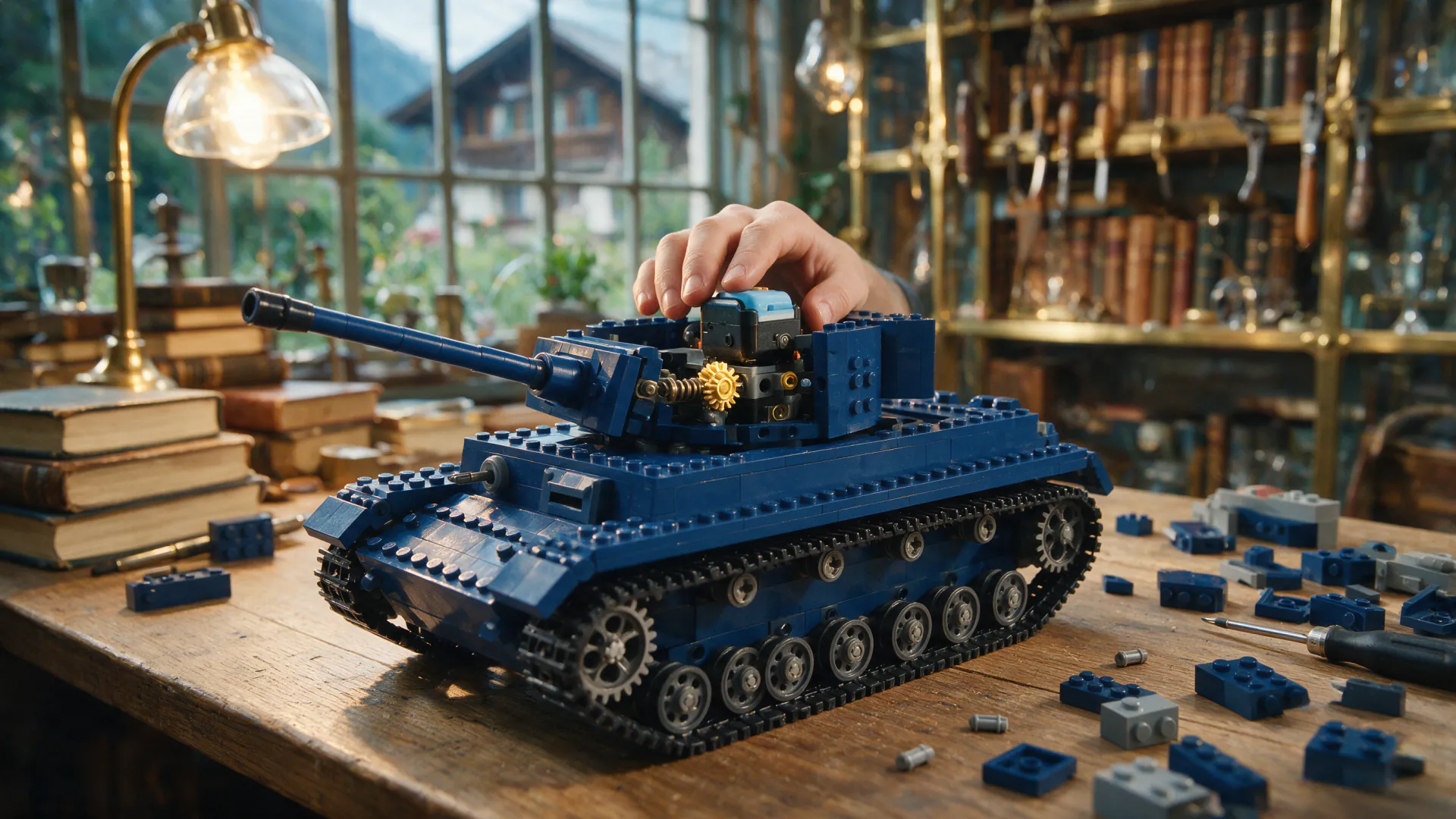
Before you ask AI for anything, answer three things: what changes when this works, who it’s for, and the exact thing that will exist when you’re done. A study helper built for the way one brain actually works. A turret that actually turns and fires. A printed book of someone’s own stones. Every one of those started with these three answers — not a prompt.
A study helper that actually works for one brain beats a plan for a platform that works for everyone. A turret that turns and fires beats a tank with twelve features and no working gun. Shrink the idea until something real can exist by the end of the week.

A study helper built for the way one person’s brain actually works. Or a study platform for every subject, every student, every school. Which one can actually exist by Friday?
The one-person version usually has a test you could run today. The platform version needs a pilot most groups haven’t scoped yet. Scope is often the real blocker, not skill.
Most people ask it to fetch something, then grade the answer like a search result. The stronger move: tell it what you’re actually stuck on, let it push back, and argue with it before you trust what it hands you. A vending machine doesn’t ask what you actually need.
Five phrases worth taking with you — not just for this build.
Go for a walk and just talk the idea out loud — messy, half-finished, like you’re explaining it to a friend. Bring the recording back. AI turns it into text and suggests a shape for it. You read that plan and fix what’s wrong before anything gets built.

You edit the plan before the machine builds anything.
This is the same desk from day one — except now you’re the one loading it. For the stone book, that’s the goal, a photo of the stone, the facts you actually trust about gems, and your own notes read aloud. Give the machine less than that and it starts guessing.
Loading the desk well is its own skill, not just one clever sentence. People call it context engineering — choosing, ordering, and keeping that material fresh at every step.
All six on the desk: a draft you'd actually send, first try.
A worked example, not a live model response.
Write down the job, the material to use, the rules to follow, what the result should look like, and how you’ll judge it. Do that for the turret’s motor code and the machine has almost nothing left to guess.
Vague instructions make the model guess who it’s for, how hard, what’s true, and what looks good. Say those out loud yourself and you can check its choices instead of guessing what it guessed.
Make me a study tool.
Flashcards from my own notes, one idea per card, in the order I actually forget them, with a question I have to answer before it shows me the answer.
Decide what someone actually needs to hold or use: a page, a slide deck, a printed document — like a book of your own stone collection — a data tool, a diagram, or an image. The shape decides what you gather, how you organise it, and which tool actually makes it.
Paste your list straight in if it’s short — like a table of your stones and where you found them. Upload it as a spreadsheet if it’s long and clean. Send a screenshot only when the words are stuck in a page you can’t copy from. Whichever way, don’t hand over more than the job needs.
A spreadsheet carries rows and columns as exact text. A screenshot only carries pixels — the machine has to guess which marks are numbers, labels, rows, and columns.
fast for a small, simple table
best for many clean rows with headers
useful when copying is impossible; easiest to misread
Ask AI to recreate the table and answer two questions you already know the answer to. If the row count, the labels, or those known answers are wrong, stop and fix the input before you ask it anything real.
Two AI systems can repeat the exact same bad source, the same wrong assumption, the same wrong maths. Agreement is a clue, not proof — check the original data, redo the maths yourself, and look for someone who didn’t just copy the first answer.
What evidence would still matter if both models agreed?
Systems trained on overlapping data can share a source, an assumption, or an error. Matching answers are worth checking, never proof on their own.
Tell it exactly what the finished file needs to contain. For a study helper, that’s which subject, which fact, and what order you’ll actually revise them in — column names, order, units, and whether it explains itself or just hands you the numbers.

Before you generate anything, be the Planner: choose the goal, the facts, the limits, the structure, the check. For the turret, that’s deciding the motor and the trigger before you touch any code. After the result arrives, be the Explorer: notice what actually happened, ask why it jammed, change one thing, stay willing to redo the plan.
decides the frame before generation
responds to evidence after generation
Instead of saying “make it cool,” name the colours, the type, the spacing, the mood of the photos — for the stone book, a few pages you actually like the look of. The guide doesn’t replace your judgement; it gives the next draft a clearer starting point.
A style guide controls the whole thing — colours, type, spacing, layout. An image guide controls just the pictures: subject, framing, light, materials, mood, and what should never appear.
the page, deck, document, or dashboard
the pictures placed inside it
The language model does not secretly click or save things by itself. The product gives it named tools, checks permission, runs the chosen action, and returns what happened so the model can continue.
The product exposes named tools with defined inputs and permissions. A controller decides whether the proposed call may run.
An AI agent is software that repeats this loop while working toward a goal. The important design questions are which actions it may take, what it can see, how much time or money it gets, and when it must stop.
A useful agent has scoped tools, a budget, a stop rule, visible state, and a human checkpoint before costly or irreversible actions.
The page loads. The test passes. The source is verified. The user approves. The budget runs out.
Pick the stop rule before starting the build.
Most working builds stack more than one stop rule together. The test passing without a human check is usually the version that ships broken.
Your first build of the turret’s motor code almost never fires right — that’s information, not failure. Look at what it actually did, fix the biggest problem, test again, and only ship once the real job works.
Then you go around again — fixing, adding, polishing. Each lap is faster than the last.
Out the other end: a real thing, live on the internet.
Use a small fix when one part is broken. Restart with a shorter plan when several systems are tangled. Ask another person or the official documentation when the same problem survives three careful attempts.
one clear failure; protect what already works
many failures or a confused plan
the same failure after three careful tries
When your attention drops, a fluent answer starts to look finished. Save the state, stand up, drink water, look away, and return with one clear test; the break protects your judgement.
A good test set includes the easy path and the strange ones. Ask the study helper about a subject it’s never seen. Feed the stone book a blurry photo. Tell the turret to fire with no target. That’s ordinary use, unusual-but-allowed use, wrong or missing information, and the one request it should simply refuse.
Coverage map, not measured scores.
Give it the weirdest honest input you can find — a subject the study helper has never seen, a wire on the turret connected backwards, a stone with no clean photo. Watch it lose that round. Change one thing. Go again.

The first honest failure almost always comes from an input nobody planned for. That’s the round doing its job, not a sign the build was wrong.
A passing build only proves that the code can be assembled. Open the public version with no saved login or secret shortcut, finish the main job, and capture proof that shows the result.
Giving someone a working page is only half the job. They also need the source, version history, build instructions, deployment path, and checks required to publish the next change without you.
the thing works now
source, version control, build, deploy, checks
Show us the thing. Explain how it works in plain words. Show us where it broke. Tell us what you changed because of that.
This is the complete making loop. Keep the human decisions visible at every step, especially what success means, what information is trusted, and what proof earns the word “finished.”
Then you go around again — fixing, adding, polishing. Each lap is faster than the last.
Out the other end: a real thing, live on the internet.
Now show us.